Choosing Faucet Handles For Sink fixtures is about more than matching a finish to the room. The handles are touched every day, often with wet or soapy hands. Their shape, spacing, and turning action affect comfort at the basin. A handle that looks elegant beneath showroom lights may feel slippery or cramped beside a small sink. Small details matter.
Plumbing and heating expert Richard Trethewey has long explained practical home systems to homeowners. A useful editorial takeaway from that approach—not a verbatim quotation—is: “A fixture should work smoothly before it tries to look impressive.” That is a sensible test for sink handles. Check whether they fit the faucet valve, whether the spout and handles leave enough room for cleaning, and whether the controls move without a stiff or loose feel. Compatibility is easy to overlook. It can mean the difference between a simple update and a frustrating return.
Materials deserve a close look, too. A brushed finish may disguise fingerprints, while polished surfaces can show water spots quickly. Consider who uses the sink, how often it gets cleaned, and whether the handle is comfortable to grip. Then compare the manufacturer’s specifications and installation guidance instead of relying on appearance alone. A minor caveat: even the best handle cannot fix a worn valve or poor installation. Still, thoughtful selection can make an ordinary morning routine feel easier—and keep the sink looking coherent. The right choice is rarely dramatic. It simply feels right, day after day.
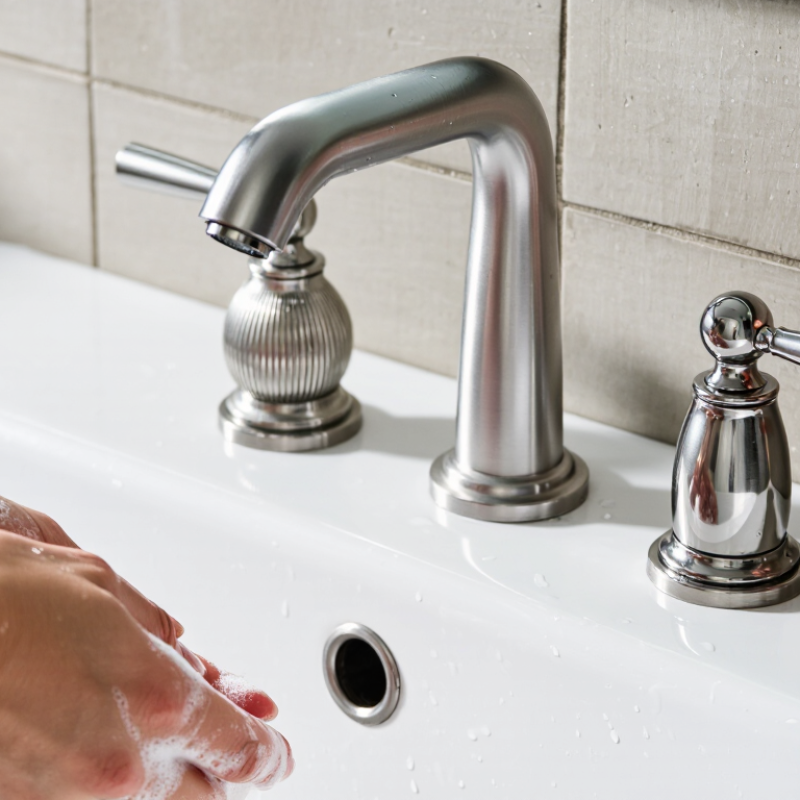
Faucet handles do more than start and stop water. Inside the fixture, a handle moves a cartridge, valve, or stem to control how much water flows. With a single-lever faucet, lifting the handle usually increases flow, while moving it sideways blends hot and cold water. Two-handle designs separate those controls: one handle adjusts cold water, the other hot. Small movements matter. A slight shift can change both the stream and the temperature at your hands.
Handle directions vary by faucet, so check the installation guide if the controls behave unexpectedly. Turn them slowly when testing a new fixture. Water pressure, supply-line temperature, and cartridge condition can all affect the result. A handle may feel smooth yet still produce a sudden temperature change if its valve is worn or poorly adjusted. That takes practice. For households with children or anyone sensitive to heat, a temperature-limiting setting can help reduce scald risk when adjusted according to the fixture instructions. The easiest handle to use is not always the most precise; comfort and predictable control matter during everyday tasks, though personal preference plays a part.
A single-handle faucet suits compact sinks and counters with limited space. One lever controls both temperature and flow, which makes quick adjustments easy when your other hand is busy. It can also work well with a one-hole sink or countertop. Check the faucet’s reach, though: a sleek, short spout may leave water splashing near the rim. Small details matter.
Dual-handle faucets give hot and cold water separate controls. They pair naturally with many three-hole sink setups and let you adjust each temperature gradually. That can be useful for rinsing delicate items or filling a basin with water at a steady temperature. The trade-off is extra hardware around the sink, which takes more room and needs more careful cleaning. Measure the distance between mounting holes before choosing a model, and check that the handles clear nearby walls or backsplashes. A dual-handle design may look balanced on a wide vanity but feel crowded on a narrow one. Neither layout is perfect for every sink; the right fit depends on available holes, counter space, and how you use the faucet each day.
Compare single- and dual-handle designs for different sink setups.
How to read the chart: A typical single-handle faucet uses one lever to adjust water flow and temperature. A typical dual-handle faucet has two handles, which control hot and cold water separately. Sink and faucet configurations can vary.
A faucet handle should work with a relaxed hand, not a painful twist. The 2010 ADA Standards for Accessible Design require operable parts to work with one hand, without tight grasping, pinching, or wrist twisting. They also set a maximum operating force of 5 lbf. For faucets, Section 606.4 points to these requirements. That limit is easy to overlook when a handle looks sturdy but feels stiff.
The Centers for Disease Control and Prevention reports that about one in four U.S. adults has a disability. A thoughtfully chosen handle can make daily routines easier for people with limited grip, arthritis, or temporary injuries. Try the control with a light touch: can you move it using your palm or the side of your hand? A long lever may help, but shape alone does not prove compliance. Measure operating force when accessibility is essential. Small details matter. A handle that passes a quick showroom test may feel different with wet hands.
Tips: Ask for the faucet’s accessibility specifications, and check the handle’s operating force with a calibrated force gauge. Confirm that the installed control remains reachable and easy to use. The ADA criteria offer a useful benchmark, but real users may still find some compliant handles uncomfortable. That deserves a second look.
| Control Type | One-Hand Operation | Grasping, Pinching, or Wrist-Twisting | Force and Accessibility Check | Practical Selection Guidance |
|---|---|---|---|---|
| Lever handle | Can generally be operated with one hand. | A suitably designed lever can be operated without tight grasping, pinching, or twisting the wrist. | Verify that the force needed to operate it does not exceed 5 lbf (22.2 N). | Often a useful option, but handle shape alone does not establish compliance; check the installed control. |
| Cross handle | May be operable with one hand, depending on its design and the user. | Some designs require grasping or wrist-twisting, which can conflict with ADA operability criteria. | Check operating force and the way the handle must be turned. | Do not assume a cross handle is accessible; assess the actual operation. |
| Round knob | May be difficult to operate with one hand for some users. | Often requires gripping and twisting. | Even if the force is below 5 lbf, the required grasping or wrist-twisting may still be an issue. | Consider a control that can be activated without a tight grasp or wrist twist. |
| Push-button control | Can be operated with one hand if the button is reachable and usable. | Typically does not require wrist-twisting; check whether the button requires pinching or precise finger control. | Measure or verify the force required to activate the control; the limit is 5 lbf (22.2 N). | Check button size, placement, and operating force in the installed configuration. |
| Sensor-activated control | May allow operation without manually turning a handle. | Usually avoids gripping and wrist-twisting, but sensor activation and any manual controls should be assessed. | Check applicable control requirements, including the 5-lbf maximum force for operable parts. | Confirm reliable activation, appropriate placement, and accessible temperature controls where provided. |
ADA reference: The 2010 ADA Standards for Accessible Design, Sections 309.4 and 606.4, require covered operable parts to be usable with one hand, without tight grasping, pinching, or twisting of the wrist, and with an operating force no greater than 5 lbf (22.2 N). Verify the faucet and its controls in the installed setting; a particular handle style does not by itself guarantee compliance.
Faucet handles shape how easily you control water during quick tasks, from rinsing a toothbrush to washing muddy hands. Flow rate matters just as much. The U.S. EPA’s WaterSense specification limits labeled bathroom faucets to 1.5 gallons per minute (gpm). Its comparison uses 2.2 gpm for a conventional faucet, making the WaterSense rate about 30 percent lower. That figure assumes rated testing conditions; your sink may feel different. (EPA, WaterSense Labeled Bathroom Faucets.)
Consider a 20-second run. At 1.5 gpm, it uses about half a gallon; at 2.2 gpm, roughly three-quarters. Small difference. Repeated every day, it adds up: EPA estimates an average family can save 700 gallons annually with WaterSense-labeled bathroom faucets. When comparing handles, notice whether a lever shuts off cleanly with wet fingers or a knob needs extra turning. A slow, awkward adjustment can leave water running. Still, lower flow does not guarantee a satisfying rinse. Water pressure, aerator condition, and basin shape affect splash and comfort. I would check the flow rating, then test the handle and rinse action at the sink. That practical check is easy to overlook.
Why Choose the Best Faucet Handles for Your Sink?
Good faucet handles should turn smoothly and stay secure through years of daily use. A loose handle can make temperature control frustrating and may signal wear inside the faucet. Look for sturdy construction, a finish suited to frequent cleaning, and replacement parts that are easy to identify. Small details matter. Check the faucet assembly’s documentation for compliance with ASME A112.18.1/CSA B125.1, a standard covering plumbing supply fittings. Requirements and accepted certifications can vary by location, so verify current local expectations with a qualified supplier or installer. Do not assume a handle’s appearance proves compliance. Feel the difference.
Tips: Turn each handle several times before installation, if possible. Watch for wobble, scraping, or uneven resistance. Keep the product paperwork and care instructions; they help when a cartridge needs service later.
Compliance is important, but it does not guarantee that every handle will feel right in your sink setup. Check handle clearance near the backsplash and confirm the controls suit the users’ grip and reach. A metal finish may look durable, yet harsh cleaners can still dull it over time. That is easy to overlook. A careful fit check and routine gentle cleaning can prevent avoidable wear.
The handle moves an internal cartridge, valve, or stem. Lifting a single lever usually increases flow.
Move the lever sideways to blend hot and cold water. Small shifts matter.
One handle adjusts cold water, and the other adjusts hot water. Gradual changes can help you reach a steady temperature.
Supply-line temperature, water pressure, or a worn cartridge can affect results. A smooth-feeling handle does not guarantee precise control.
A single-handle design often takes up less space and allows quick adjustments. Check the spout reach to avoid splashing near the rim.
It can suit a three-hole sink and offers separate hot and cold controls. The extra hardware needs more cleaning.
Measure the distance between mounting holes. Also check whether the handles clear nearby walls or backsplashes.
Check the installation guide, then turn the handle slowly. A temperature-limiting setting may help reduce scald risk when adjusted as instructed.
Choosing the right Faucet Handles For Sink can make everyday use more comfortable and precise. Handles control how water starts and stops, as well as how its temperature is adjusted. A single-handle design combines these controls in one movement and can suit compact sinks, while a dual-handle design provides separate adjustments for hot and cold water. The best choice depends on the sink layout, available space, and the preferences of the people who use it.
Accessibility, efficiency, and durability also matter. For accessible operation, check that the handle can be used with one hand and requires no more than 5 lbf of force. WaterSense-labeled models use a flow rate of 1.5 gallons per minute or less, helping reduce water use without sacrificing practical performance. Finally, look for durable construction and compliance with ASME A112.18.1/CSA B125.1, which can help ensure the faucet meets established plumbing-product requirements.
